Case study
NoDig — seven domains, one network
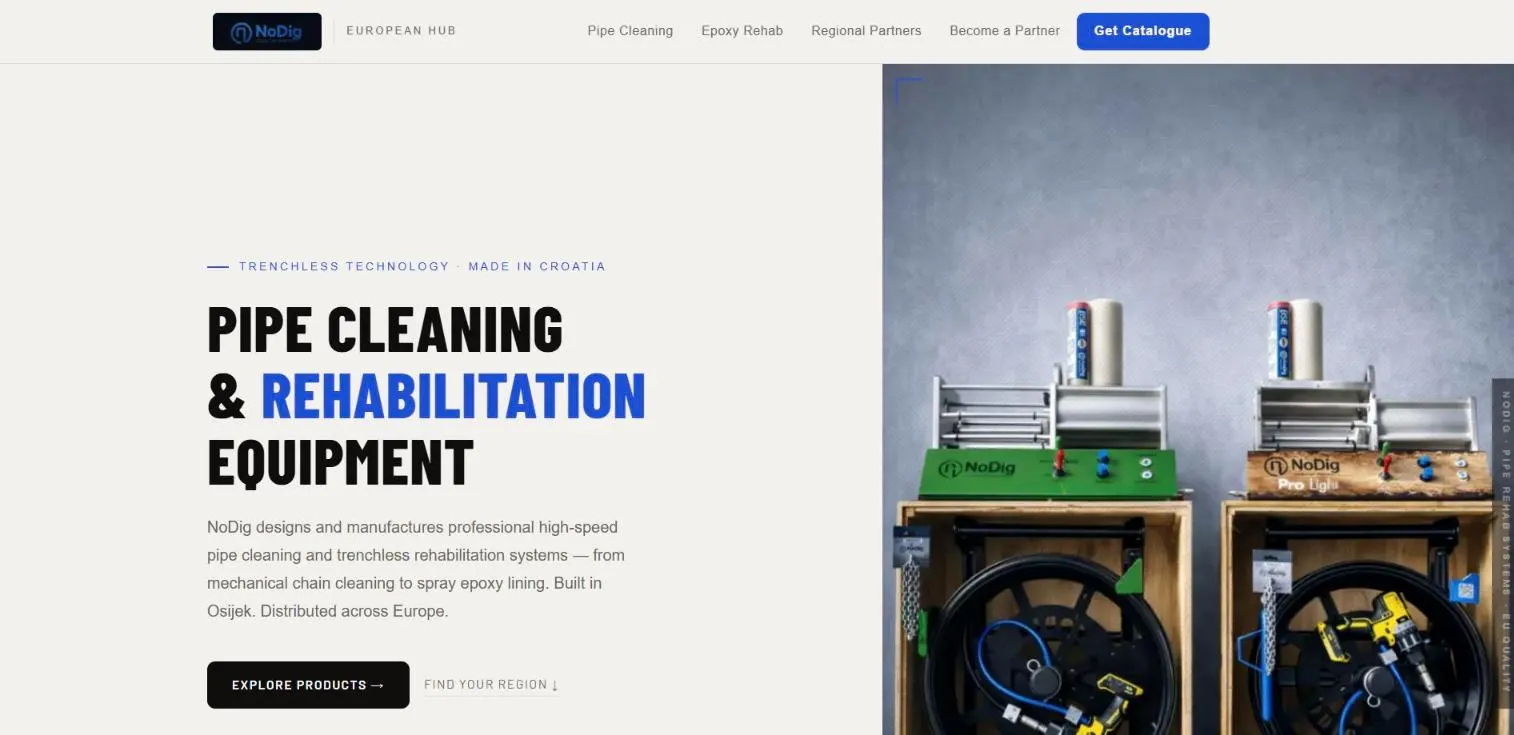
A manufacturer in Osijek sells trenchless pipe cleaning and rehabilitation equipment through six independent regional partners. This is not the problem of translating one website into eight languages. It is the problem of getting six separate companies and a manufacturer to rank each in their own market, without competing with each other for the same terms.
Why this is not a translation job
NoDig manufactures in Osijek and sells through a network of authorised regional partners. Germany, Slovenia and Austria, Serbia and the Western Balkans, Spain and Italy, France and francophone Europe — each of those markets is covered by a separate company with its own stock, its own pricing and its own technical support.
Put everything on one domain with language folders and the partner in France is selling from somebody else’s address. No domain of their own, no contact of their own, and none of what a buyer spending several thousand euros on a machine checks first: exactly who they are dealing with, and who turns up when it breaks.
Hence seven domains. Six belong to a market; the seventh belongs to everyone.
Every domain is a self-contained language cluster
No market is a single language. The Croatian domain runs Croatian, English and German, because the manufacturer takes international enquiries directly. The Slovenian one covers Slovenia and Austria, so German rides along with Slovenian. The Spanish one covers Italy, so Italian rides along with Spanish. English is everywhere, as the common denominator for everything that falls outside a local language.
Within each domain the language versions declare each other with hreflang, reciprocally and with their own x-default. Reciprocity is not a stylistic detail: a one-way declaration is ignored, so a cluster that is not closed does not exist as far as a search engine is concerned.
Eight languages in total, 489 addresses across the sitemaps. The sitemaps carry hreflang themselves, as xhtml:link, not only the page head.
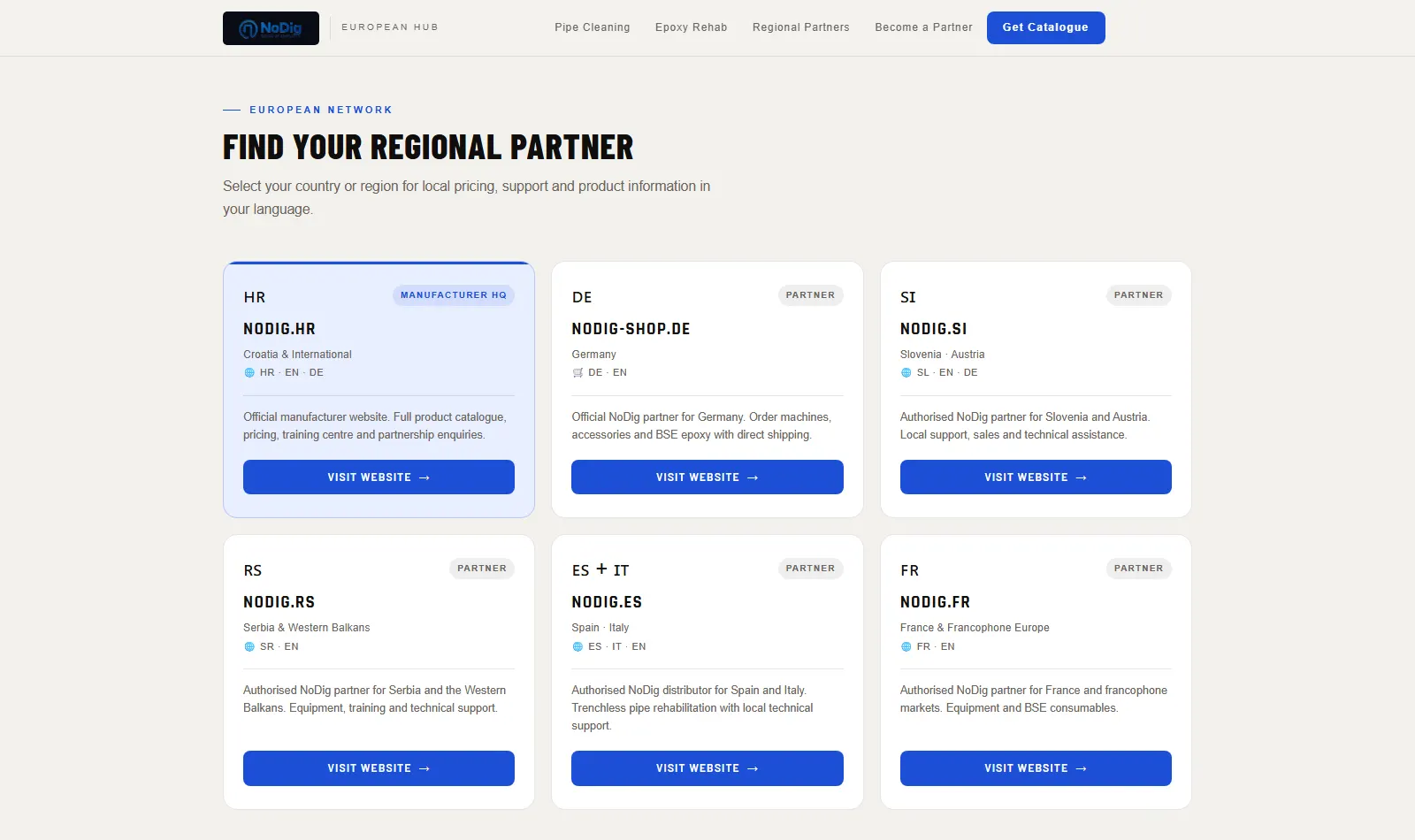
- nodig.hr — Croatia and international, Croatian · English · German
- nodig-shop.de — Germany, German · English
- nodig.si — Slovenia and Austria, Slovenian · English · German
- nodig.rs — Serbia and the Western Balkans, Serbian · English
- nodig.es — Spain and Italy, Spanish · Italian · English
- nodig.fr — France and francophone Europe, French · English
The hub exists because no partner domain can speak for the network
nodig.eu.com is in English and has just four pages: two on the technology, the list of regional partners, and a page about joining the network. Deliberately small — the hub is not a seventh catalogue.
It does two things no partner domain can. It sends a buyer from a country with no partner to the nearest address or straight to the manufacturer, rather than having the French site try to serve them in a language they do not read. And it recruits new partners for territories that are not covered yet.
That is why the hub is the only site in the network where "Become a Partner" is a top-level menu item, sitting beside "Get Catalogue".
What is shared is what carries the search
The catalogue follows the same logic on every domain: category, then product. Three mechanical chain-cleaning machines — V1, V8 and Mini6 — and the epoxy side: ProLight, ProLight2, BSE and The Pipe Boy. Product names are identical everywhere because the product is identical everywhere, and that is how buyers search for it.
The visual identity is not uniform across the network. The domains were built at different times and for different markets, so the hub looks unlike the Croatian site and the Croatian site unlike the Slovenian one. What is shared is what carries the search and the order: the catalogue structure, the product names, the route from category to item, and the enquiry form at the end of that route.
Static, and a migration that did not break the links
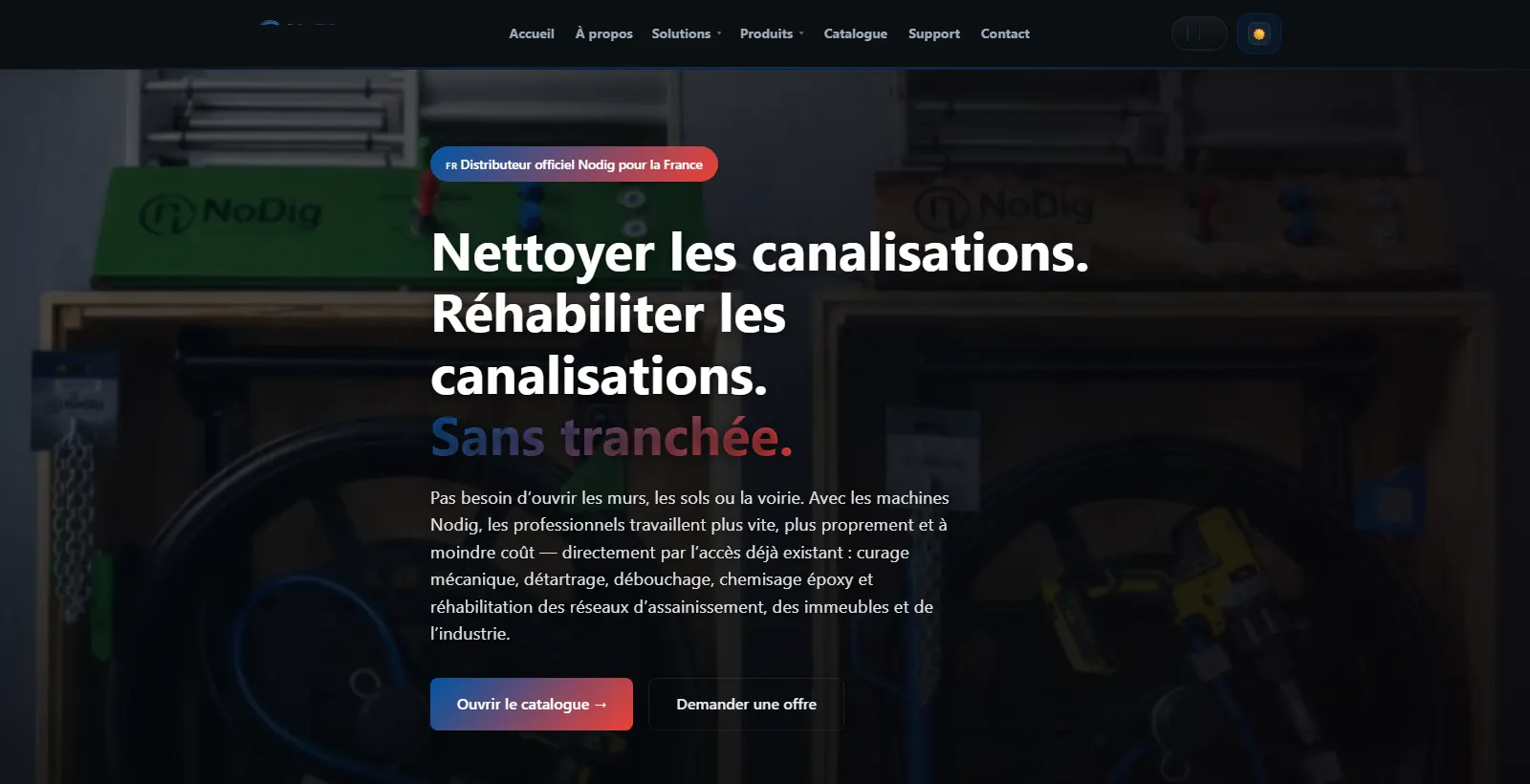
No domain in the network runs a CMS. It is all static HTML, CSS and JavaScript — seven sites somebody has to maintain for years, and not one of them can fall over because of a plugin version.
The Croatian domain used to run WordPress. The machine manuals lived at addresses of the form /wp-content/uploads/…, and those addresses were already out in the world, in emails, in quotations and on other people’s websites. A migration that deletes them looks tidy in the file tree and is expensive in practice, because every one of those links becomes a 404.
So the paths were kept. Verified while writing this: the English V1 manual still opens at its old WordPress address.
How it is described to machines
Search engines and AI tools read this as well as people, so it is described for them too. The hub carries Organization, LocalBusiness, WebSite, WebPage, an ItemList covering the whole range, and an FAQPage answering questions about pipe diameters, training and how to become a distributor.
Alongside that sit llms.txt and a robots.txt that admits AI crawlers by name. None of that wins Google positions on its own, but for a manufacturer whose product is explained through the question "what do you rehabilitate a pipe with, without digging", it matters whether the answer is assembled from their pages or from somebody else’s.
- Organization, LocalBusiness, WebSite, WebPage, ItemList and FAQPage on the hub
- Hreflang in the sitemaps as well as the page head
- llms.txt, and a robots.txt naming GPTBot, ClaudeBot and the rest
- An enquiry form on every domain, routed to the partner covering that market
What this is, and what it is not
There are no numbers here either — no traffic, no enquiries, no positions. They were not measured, so they are not claimed. The same rule holds across the portfolio.
What can be checked: seven domains are live, each a closed language cluster of its own, eight languages in total and 489 addresses across the sitemaps. Every partner has an address they can call theirs, and the manufacturer has one place from which to address the whole of Europe — and to recruit for the markets it does not have yet — without treading on any existing partner.
Selling into several markets, through partners or on your own?